Table of Contents
ToggleHarris pest control products have earned a reputation among DIYers for one simple reason: they work without requiring a second mortgage or a hazmat suit. For homeowners tired of watching roaches scatter at midnight or waking up with mystery bites, Harris offers affordable, accessible solutions that don’t demand a pest control license to apply. The brand’s been around since 1922, formulating products specifically for residential use, meaning they’re designed for people who want results but aren’t planning to spray an entire apartment building. Whether dealing with roaches, bed bugs, ants, or spiders, Harris provides multiple product formats to match different infestation levels and application preferences.
Key Takeaways
- Harris pest control products offer affordable, effective solutions for DIYers to tackle roaches, bed bugs, ants, and spiders without professional licensing or expensive service calls.
- Harris Roach Tablets contain 99% boric acid and work best when combined with pyrethroid-based sprays to knock down active infestations while residual treatments prevent future invasions.
- Correct pest identification, thorough application in cracks and crevices (not room centers), and appropriate PPE are essential for effective Harris pest control use.
- Harris falls in the mid-price range, typically costing $8–35 per product versus professional pest control services starting at $150 per call, making it a cost-effective DIY alternative.
- Multiple applications spaced 7–14 days apart are often necessary, and if an infestation persists after three treatments or spreads to multiple rooms, professional help may be needed.
- Harris products are widely available at major retailers like Home Depot and Lowe’s, offering accessibility advantages over specialty brands that require online-only ordering.
What Is Harris Pest Control and Why Homeowners Trust It
Harris is a family-owned company that’s been manufacturing pest control products for over a century. Unlike professional-grade formulations that require applicator certifications, Harris designs its products for direct consumer use, available at hardware stores, home centers, and online retailers without special licensing.
The brand focuses on active ingredients proven effective by independent research: boric acid for roaches, diatomaceous earth for crawling insects, and pyrethroid compounds for contact kills. Harris doesn’t reinvent the wheel: they apply known chemistry in user-friendly formats like tablets, sprays, powders, and traps.
Homeowners trust Harris for three practical reasons. First, the products come with clear application instructions, including coverage rates and reapplication schedules. Second, many formulations are low-odor and dry clear, making them suitable for occupied homes rather than requiring evacuation. Third, Harris offers both contact killers (immediate knockdown) and residual treatments (long-term prevention), a combination that addresses active infestations and future invasions.
The brand’s transparency about active ingredients and concentrations also builds confidence. Each label lists exactly what’s inside, typical efficacy timelines, and safety precautions. For DIYers who want to understand what they’re applying and why, that clarity matters more than vague marketing promises.
Top Harris Pest Control Products for Common Household Pests
Harris Roach Tablets and Sprays
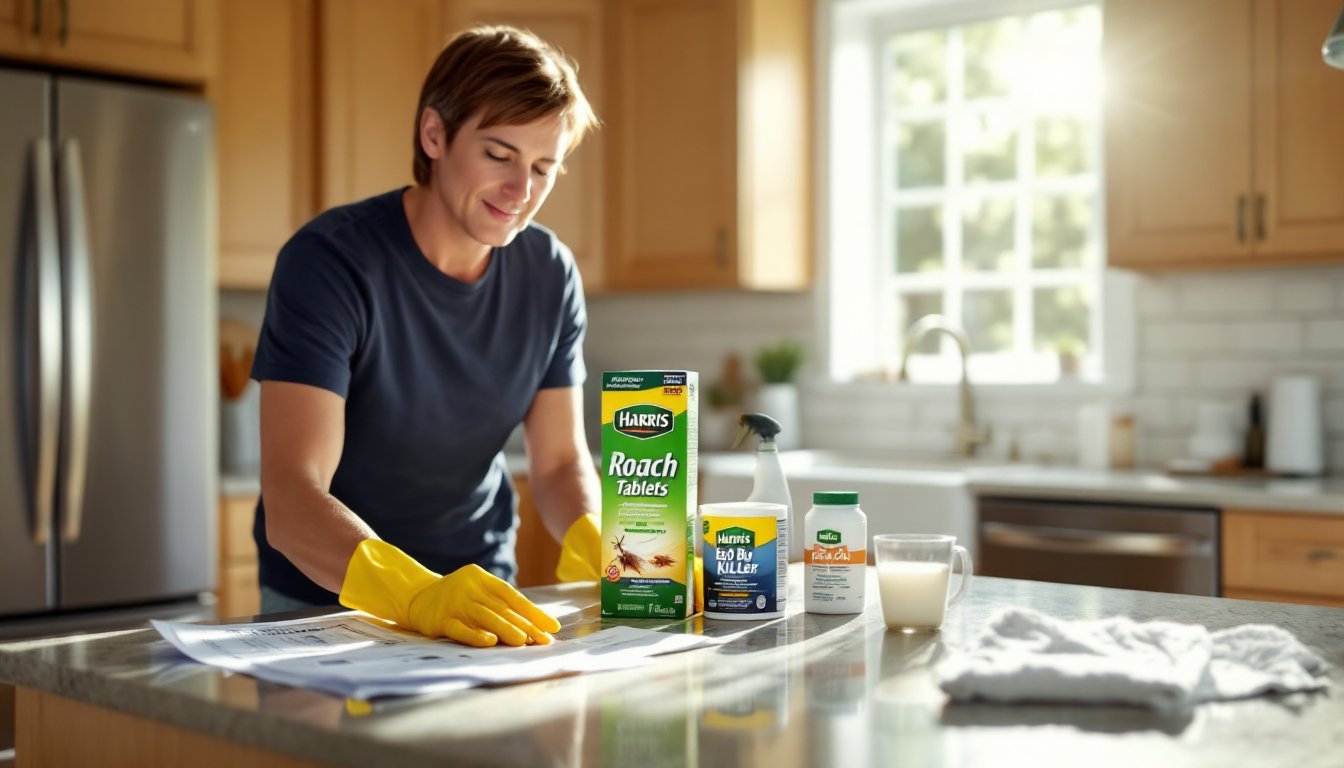
Harris Roach Tablets contain 99% boric acid, a stomach poison that roaches ingest while grooming. Place tablets behind appliances, under sinks, along baseboards, and in cabinets where roaches travel, not in the middle of floors where kids or pets might access them. Each tablet lasts up to one year if kept dry.
The tablets work best for German cockroaches and American cockroaches in kitchens, bathrooms, and basements. They won’t deliver instant results: roaches carry boric acid back to harborage areas, affecting the colony over 7–14 days. For severe infestations, combine tablets with Harris Roach Spray (a pyrethroid-based contact killer) to knock down visible roaches while the tablets handle hidden populations.
Harris also makes a Roach Powder (boric acid in powder form) for dusting into wall voids, attics, and crawl spaces. Use a hand duster to apply a light, even coating, heavy piles repel roaches instead of attracting them. When choosing between different pest control techniques, understanding the lifecycle of your target pest determines which format works best.
Harris Bed Bug Killers and Prevention Solutions
Harris Bed Bug Killer is a pyrethroid-based spray that kills bed bugs, eggs, and nymphs on contact. It’s available in ready-to-use (RTU) spray bottles and gallon concentrate for larger areas. The active ingredients, typically a combination of pyrethrins and piperonyl butoxide, disrupt the insect’s nervous system.
Application requires thoroughness, not speed. Strip the bed completely and inspect seams, tufts, and piping on the mattress and box spring. Spray all cracks, seams, and folds until slightly damp, then treat the bed frame, headboard, and any furniture within 10 feet of the bed. Bed bugs hide in electrical outlets, baseboards, picture frames, and even wallpaper seams, so a single pass won’t cut it.
Harris also offers bed bug traps that intercept bugs traveling between the floor and bed legs. These traps won’t eliminate an infestation but help monitor activity and catch bugs that avoid treated areas. For mattress and box spring protection, Harris makes zippered encasements that trap any bugs inside and prevent new ones from entering.
Safety note: Bed bug treatments often require multiple applications spaced 7–14 days apart to catch newly hatched nymphs. If an infestation persists after three treatments, or if it’s spread to multiple rooms, call a licensed pest control professional. Some bed bug populations have developed resistance to pyrethroids, requiring different chemistry or heat treatments that DIY products can’t deliver.
How to Use Harris Pest Control Products Effectively
Effective pest control starts before you open the product. Identify the pest correctly, what works for ants won’t touch termites, and roach baits won’t kill bed bugs. Take a clear photo or capture a specimen in a sealed bag, then compare it to reference images from your local extension office or an online pest ID guide.
Read the entire label before mixing or applying anything. The label tells you:
- Application rate (coverage per ounce or tablet)
- Where to apply (cracks and crevices vs. broadcast)
- Restricted areas (food prep surfaces, pet bedding)
- Reapplication interval (some products allow retreatment after 7 days: others require 30)
- PPE requirements (gloves, goggles, respirator)
Prep the area by cleaning surfaces where you’ll apply products. Dust, grease, and grime reduce contact between the pest and the active ingredient. For sprays, vacuum first to remove debris, then apply the product and let it dry completely before replacing furniture. For baits and tablets, skip the cleaning in application zones, roaches and ants follow scent trails, and excessive cleaning disrupts those paths.
Measure and mix accurately if using concentrates. A kitchen measuring cup works, but a graduated plastic beaker (available at hardware stores) gives more precision. For homeowners just getting started with treatments, reviewing pest control for beginners can help avoid common application mistakes.
Apply products in the right locations. Pests don’t hang out in the middle of rooms, they travel along edges, behind appliances, and inside wall voids. Focus treatments on:
- Cracks and crevices along baseboards, door frames, and window sills
- Behind and under appliances (refrigerator, stove, dishwasher, washer/dryer)
- Plumbing penetrations where pipes enter walls or floors
- Attics and crawl spaces where pests enter from outside
Monitor results and adjust as needed. Check treated areas every few days for dead insects, new activity, or signs the infestation is shifting to untreated zones. If you’re not seeing a reduction in activity after 14 days, reassess your identification, application technique, or product choice. Modern pest control ideas emphasize integrated approaches rather than relying on a single product.
Wear appropriate PPE. At minimum, use nitrile gloves and safety glasses when handling any pest control product. For sprays and dusts, add a respirator rated for pesticides (look for NIOSH-approved organic vapor cartridges or N95 masks, depending on the formulation). Long sleeves and pants protect skin from accidental contact.
Comparing Harris to Other DIY Pest Control Brands
Harris competes directly with brands like Ortho, Raid, Hot Shot, and Terro in the consumer pest control market. Each brand has strengths depending on the pest and application method.
Harris vs. Ortho: Ortho offers a broader product line, including outdoor perimeter treatments and granular insecticides for lawns. Harris focuses more on indoor applications with simpler formulations. Ortho’s Home Defense Max is a popular perimeter spray, but Harris Roach Tablets often outperform Ortho’s bait stations for heavy German roach infestations because of the higher boric acid concentration.
Harris vs. Raid: Raid emphasizes fast knockdown with aerosol sprays. If immediate results matter, killing a visible roach or ant trail, Raid’s pyrethroids work faster. But Raid products typically don’t offer residual protection beyond a few days. Harris sprays and tablets provide longer-lasting control, making them better for treating the source of an infestation rather than just the symptoms. Evaluating whether to invest in professional services or handle it yourself often comes down to pest control vs DIY cost-benefit analysis.
Harris vs. Hot Shot: Hot Shot specializes in foggers and bug bombs for whole-room treatments. These products can be effective for flying insects (fleas, gnats, flies) but often fail against roaches and bed bugs that hide in cracks where fog can’t penetrate. Harris’s targeted sprays and powders deliver active ingredients directly to harborage areas, which generally produces better results for crawling insects.
Harris vs. Terro: Terro dominates the ant bait market with liquid bait stations that use borax as the active ingredient. For ants, Terro baits often outperform Harris ant products because the liquid format is highly attractive to sugar-feeding species. Harris, but, offers better options for roaches, bed bugs, and general crawling insects where Terro has fewer products.
Price-wise, Harris falls in the mid-range. A 12-pack of Harris Roach Tablets typically costs $8–12, while a gallon of Harris Bed Bug Spray runs $25–35. That’s more expensive than basic Raid aerosols but significantly cheaper than professional treatments, which can start at $150 for a single service call. When weighing options, many homeowners consult resources like HomeAdvisor to compare DIY product costs against professional service quotes.
Harris products are widely available at Lowe’s, Home Depot, Ace Hardware, and online through Amazon and the Harris website. That accessibility gives it an edge over smaller specialty brands that require online-only ordering.
Conclusion
Harris pest control products deliver practical, accessible solutions for homeowners willing to do the work themselves. The brand’s century-long track record, transparent labeling, and proven active ingredients make it a solid choice for tackling roaches, bed bugs, ants, and other common household pests without calling in professionals for every issue.